Navigation links and contextual links solve different problems. Navigation establishes the durable shape of a site; contextual links help a reader continue a specific line of thought. When both point to the same URL, their labels may compete in ways that are difficult to observe—and easy to oversimplify.
Navigation is an information architecture decision
I add a page to global navigation when a large share of visitors should be able to predict that it exists and reach it from many locations. That is a stronger requirement than “this page is important for SEO.” A header with too many choices weakens orientation, pushes priority items out of view, and becomes especially costly on small screens.
Contextual links have a lower threshold. They can connect a definition to a deeper explanation, a finding to its methodology, or a recommendation to the tool that implements it. Their strength is specificity: the surrounding sentence tells readers why the destination matters at that moment.
Why the distinction matters for selective link priority
Headers usually occur before the main article in the DOM. If Google consistently selected the first text anchor to a destination, a broad navigational label could become the selected description while a more precise body anchor was omitted. That possibility led to a practical concern in my original study: sites with large menus might unintentionally limit the anchor variation associated with important pages.
But “first” may not be the only feature. Search systems can recognize boilerplate, repeated templates, main content, and other page regions. It is plausible that a contextual link could be treated differently from a sitewide navigation link. The honest answer is that a small experiment can observe one configuration, not define a permanent rule for every site.
The extension used in this study
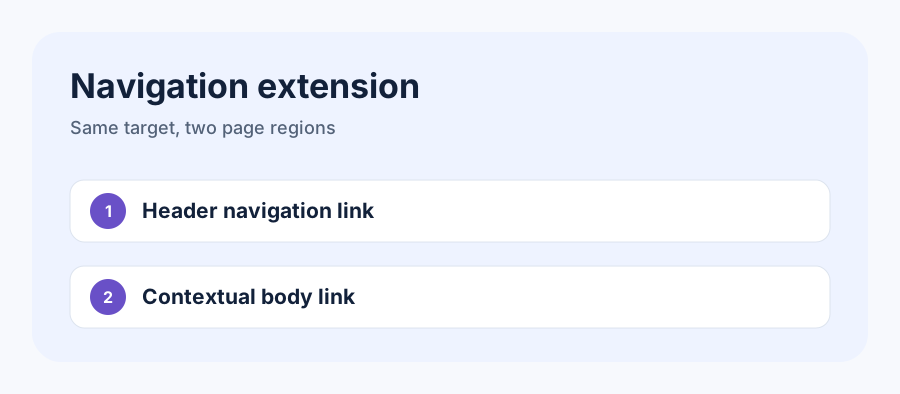
Three interior articles link to the homepage twice. The header uses the same navigation label on all three pages. Later, each article uses the same contextual label inside a sentence. The counts are equal, the target is identical, and the navigation link appears first in the HTML. This removes one common confound: comparing a sitewide anchor repeated many times against a body anchor used only once.
The full preregistration, current status, and eventual exports are maintained in the current selective-link-priority research record. This contextual link is the second link from this page to the homepage; the first is the header navigation link above.
Common implementation mistakes
Duplicated mobile and desktop menus
A responsive design sometimes renders two full menus and hides one with CSS. A person sees one navigation link, while the DOM contains two. I prefer one semantic navigation structure that changes layout responsively. When separate structures are unavoidable, they should be audited as separate links rather than treated as a single visual component.
Logo, wordmark, and “Home” all pointing home
Several homepage links can appear before the article begins: a linked logo image, a linked brand name, a “Home” menu item, and a breadcrumb. Each may be defensible, but together they complicate both accessibility and experimentation. In this study, the brand is plain text and the header contains only one homepage anchor.
Generic navigation labels
Short labels are useful in menus, but “Resources” or “Learn” may describe a container rather than a destination. When a page deserves a permanent place in navigation, I try to choose a label that remains concise while setting a reasonable expectation. The contextual link can then provide the detail that would make the menu unwieldy.
A decision framework I use
- Predictability: Would a new visitor reasonably look for this destination in the global menu?
- Frequency: Does the task occur across many sessions, or only in a specific reading context?
- Space cost: What higher-priority option becomes harder to find when this item is added?
- Label quality: Can the destination be named clearly in a short navigation phrase?
- Template integrity: Is the link rendered once, consistently, without hidden clones?
This framework keeps the SEO question in proportion. Navigation should not be redesigned solely to manufacture anchor text. If a contextual link is the better user experience, use it. If a destination belongs in the global architecture, include it and make its label clear.
How I will interpret the result
If the navigation label appears and the contextual label does not, the observation will be consistent with first-text selection in this configuration. If the contextual label appears alone, page region may be a meaningful selector. If both appear, the system is less restrictive than the original text-link pattern suggested. If neither appears despite a successful canary, the outcome remains inconclusive because the Links report is sampled.
No single outcome justifies removing useful menus or forcing keyword-rich body links. The value of the extension is narrower: it can tell us whether the simplest first-link expectation survives one realistic navigation scenario.
A reversed fragment-link control
This page also contributes a separate crossover test without changing the navigation condition above. The first link in this pair, the topaz section-jump notes, points directly to a section using a fragment identifier. The later slate full-page notes points to the document without a fragment. The homepage presents the same two URL forms in the opposite order.
This crossover helps distinguish an order effect from a URL-form effect. If the first anchor wins on both source pages, the outcome is consistent with consolidation followed by source-order selection. If base URLs win regardless of order, normalization may favor the document URL. If both phrases appear, the reporting layer may preserve more anchor variation than the original study suggested.
What I would not conclude from this test
Even a clean result would not show that navigation is weak, that body links always pass more value, or that menus should be reduced for ranking purposes. The experiment observes which labels appear in one reporting system under one small site architecture. It does not measure PageRank flow, click behavior, crawl priority, or the full set of signals Google may attach to a destination.
I would also resist applying a homepage result directly to product pages, category hubs, or very large publisher sites. Home links are unusually repetitive and may be recognized differently from other navigation items. The useful outcome is a better prior for future audits—not permission to redesign an information architecture around a single anchor-text observation.
This page is the target of replication test three and one of three source pages in the navigation extension, and one source in the fragment crossover.